
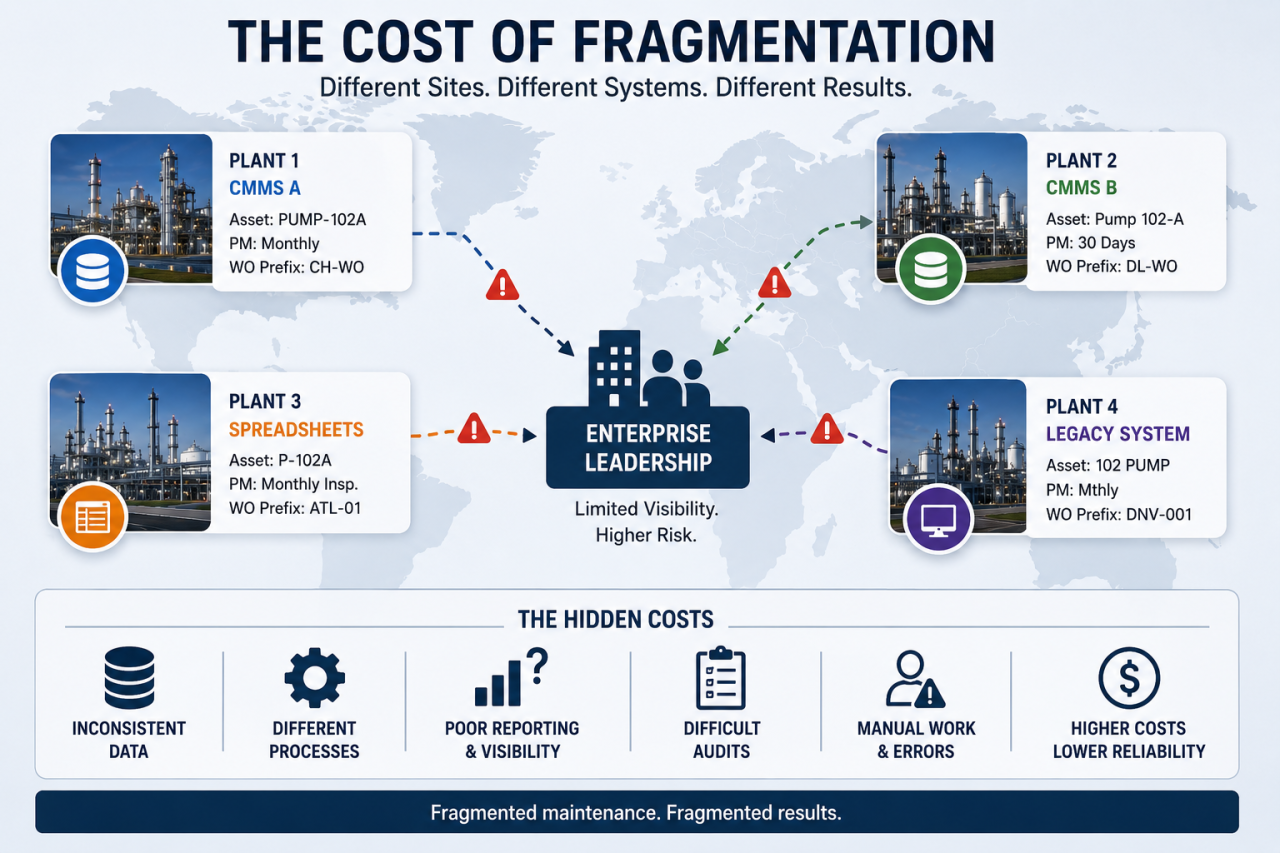
Yet many organizations are still held back by inconsistent processes, disconnected systems, unreliable data, and limited visibility across sites. Corporate leaders may believe maintenance practices are standardized, but the reality on the plant floor is often very different. Each facility may have its own way of managing assets, scheduling preventive maintenance, naming equipment, and reporting performance.
Over time, those local differences become enterprise-level barriers. They make it harder to compare site performance, share best practices, manage compliance, and make confident decisions about asset strategy.
The challenge is not simply one of process. It is a challenge of scale, governance, and technology. Without a standardized approach to maintenance, multi-site manufacturers struggle to build the reliability, visibility, and control needed to improve performance across the business.
The Hidden Cost of Fragmented Maintenance Systems
One of the most common barriers to standardization is the use of different CMMS tools, spreadsheets, and legacy systems across sites.
Mergers, acquisitions, regional autonomy, and historic technology decisions often leave manufacturers with a patchwork of maintenance environments. One facility may use a modern maintenance system, another may rely on spreadsheets, while a third may operate on a platform that is decades old.
At a local level, this can appear manageable. Each site may still be tracking work orders, scheduling tasks, and recording maintenance activity. The problem emerges when leadership needs to compare performance, identify risk, or build an enterprise-wide view of asset health.
Different systems often mean different data structures, maintenance workflows, reporting capabilities, and administrative effort. They also increase the burden on IT teams asked to support multiple platforms with limited standardization.
When maintenance information is scattered across systems, leaders lose the ability to see a complete picture of asset performance. Decisions become slower, less consistent, and more reactive because the data needed to act with confidence is fragmented.
When Preventive Maintenance Means Something Different at Every Site
Preventive maintenance programs are intended to create consistency and reliability. In many multi-site organizations, however, PM practices vary significantly from plant to plant.
One facility may have mature condition-based maintenance practices. Another may rely primarily on calendar-based inspections. Some sites may complete PM tasks consistently, while others routinely defer them because of staffing shortages, production pressure, or unclear priorities.
The result is a maintenance program that appears standardized in name but not in execution.
When every site defines PM differently, leaders cannot compare performance with confidence. A high PM completion rate at one facility may reflect a mature reliability program. At another, the same metric may hide deferred work, inconsistent task definitions, or different inspection standards.
At the enterprise level, this creates real business risk. Asset reliability varies between locations. Maintenance costs become difficult to benchmark. Best practices remain isolated. Equipment failures become harder to anticipate. Continuous improvement loses momentum because the organization is not working from a common operational foundation.
Asset Naming Conventions: A Small Problem That Creates Big Challenges
Asset naming conventions rarely receive executive attention until reporting becomes unreliable.
Consider a manufacturer trying to compare pump reliability across five facilities when each site uses a different naming structure. One plant identifies equipment by location. Another uses asset type. A third relies on historic naming conventions that only local teams understand.
Without a common asset hierarchy and naming standard, organizations face duplicate asset records, inaccurate reports, longer onboarding times, and limited scalability for enterprise initiatives.
Standardized asset structures are the foundation of meaningful maintenance analytics. If assets cannot be consistently identified across facilities, enterprise-wide reliability programs become harder to implement and harder to trust.
This is where asset data becomes more than an administrative concern. It becomes a business performance issue. Without a reliable asset hierarchy, leaders cannot confidently compare like-for-like performance, prioritize investments, or understand where reliability improvements will have the greatest impact.
The Enterprise Reporting Gap
Manufacturing leaders need visibility across sites. They need to understand how maintenance performance varies by location, where risk is increasing, and where resources should be focused.
Non-standardized maintenance environments make this difficult.
When data comes from different systems, follows different processes, and uses different naming conventions, enterprise-level reporting becomes a manual and time-consuming exercise. Questions that should be straightforward become difficult to answer:
Which sites have the highest maintenance costs?
Where is preventive maintenance compliance declining?
Which critical assets are most prone to failure?
How does performance compare across regions, plants, or asset classes?
Without trusted reporting, leadership teams are forced to make decisions using incomplete information. Opportunities for optimization are missed, and performance issues can remain hidden until they become major operational problems.
For manufacturers under pressure to improve throughput, manage costs, and reduce operational risk, this lack of visibility limits the ability to act decisively.
Why Audits Become More Difficult
Whether driven by regulatory requirements, corporate governance, customer expectations, or industry certifications, audits are a reality for manufacturers.
A standardized maintenance program makes audit preparation more manageable by ensuring that processes, records, and documentation are handled consistently across facilities.
In non-standardized environments, the opposite happens. Documentation is stored differently at each site. Maintenance records are difficult to locate. Compliance evidence varies in quality. Reporting requires manual effort. Corrective actions are harder to track and validate.
When auditors request maintenance records, organizations should be able to provide accurate information quickly and confidently. Inconsistent systems and processes can turn what should be a routine exercise into a stressful scramble.
For senior leaders, the issue is not only audit effort. It is governance. If compliance evidence is difficult to find, inconsistent in format, or dependent on local knowledge, the organization has less control than it may appear to have.
The Path Toward Standardization
Standardizing maintenance across multiple sites does not happen overnight. It requires alignment across operations, maintenance, engineering, IT, and finance. It also requires a clear governance model that protects standards as the organization grows.
Successful manufacturers typically focus on several foundational steps.
Establish Common Maintenance Processes
Define enterprise-wide standards for work management, preventive maintenance, asset criticality, reliability practices, and documentation. These standards should be practical enough for local teams to adopt while consistent enough to support enterprise reporting and governance.
Create a Standard Asset Hierarchy
Develop consistent naming conventions and asset structures that can be applied across every facility. This creates the data foundation needed to compare performance, analyze reliability trends, and scale improvement programs.
Consolidate Maintenance Systems Where It Makes Sense
Move toward a unified EAM approach that supports enterprise visibility while still accommodating site-specific operational needs. The goal is not standardization for its own sake. The goal is to create a trusted foundation for better decisions, more consistent execution, and scalable improvement.
Standardize KPIs and Reporting
Align maintenance metrics so performance can be measured consistently across locations. Standard definitions for KPIs such as PM compliance, downtime, MTBF, MTTR, maintenance cost, and asset availability help leadership understand what is really happening across the network.
Build a Governance Framework
Assign ownership for maintaining standards, managing data quality, and ensuring consistent use of processes across sites. Without governance, standardization can erode as teams adapt systems and processes locally over time.
Turning Maintenance Into a Strategic Asset
For multi-site manufacturers, maintenance standardization is about more than administrative efficiency. It is about creating the visibility, consistency, and control required to improve reliability, manage risk, and support long-term business goals.
Organizations that continue operating with fragmented systems and inconsistent processes often struggle to scale improvement beyond individual facilities. Those that invest in standardization create the conditions to leverage maintenance data, expertise, and best practices across the entire enterprise.
The question is no longer whether multi-site manufacturers should standardize maintenance. It is whether they can continue making enterprise decisions with fragmented data, inconsistent processes, and limited visibility into asset performance.
Ultimo helps manufacturers move from fragmented maintenance execution to a more unified approach to Enterprise Asset Management. By standardizing processes, asset structures, and reporting across sites, organizations can build the visibility and control needed to improve reliability, strengthen compliance readiness, and make better decisions at scale.
This is the foundation for Intelligent Asset Management: a more connected, consistent, and outcome-led approach to managing assets across the enterprise.