
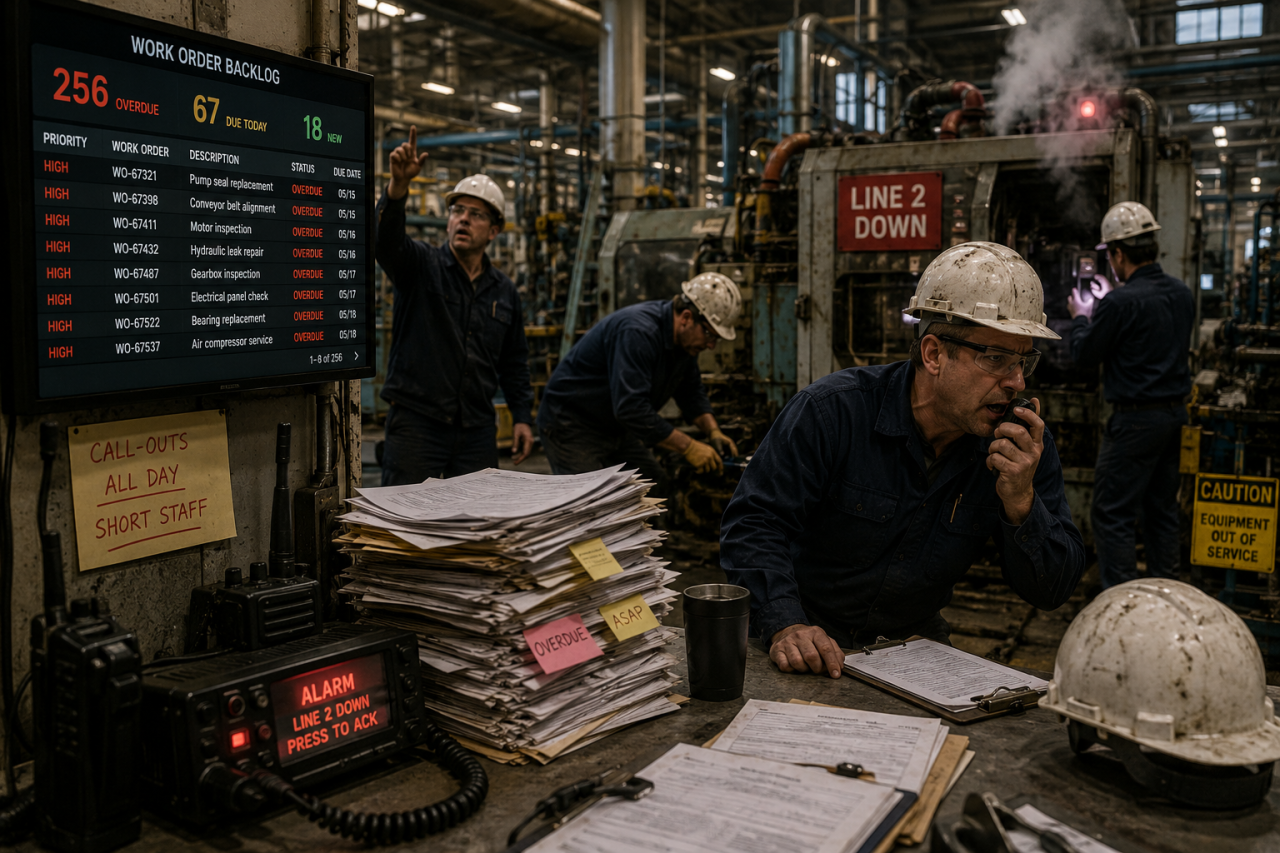
For years, maintenance leaders have talked about “breaking out of firefighting mode.” Yet our latest North America–specific survey data shows that many teams remain trapped in exactly that cycle. Despite new tools, new expectations, and rising pressure, the day-to-day reality still looks the same: chasing breakdowns, juggling backlogs, and trying to keep production running with limited visibility and even less time.
The real question isn’t why teams fall into reactive maintenance. It’s why they can’t get out.
A System Built on Good Intentions and Weak Foundations
When respondents described the maturity of their maintenance strategy, the pattern was unmistakable. Most sit somewhere between reactive and preventive. Only a small minority operate with true asset performance discipline.
This isn’t a lack of ambition. It’s a lack of foundation.
Teams report the same challenges at almost identical frequency:
Limited visibility into asset performance
Poor or inconsistent data
Aging equipment
Skilled labor shortages.
No single issue dominates because each one reinforces the others. Poor data leads to guesswork. Guesswork leads to skipped preventive tasks. Skipped tasks lead to breakdowns. Breakdowns lead to firefighting.
It’s a loop and it keeps pulling teams back into crisis.
The Backlog That Never Stops Growing
One of the strongest signals in the survey is the weight of the maintenance backlog. It rarely appears alone. It shows up alongside poor data, unplanned downtime, labor shortages, and visibility gaps.
A backlog isn’t just a list of overdue work. It’s a structural indicator that the system is generating more demand than the team can absorb.
Common drivers include:
Work orders that never get closed because mobile adoption is low
Preventive tasks skipped due to emergency call offs
Spare parts delays that stall planned work
Compliance tasks piling up due to manual reporting.
This is the operational reality leaders are fighting against - not one big problem, but a system that keeps accelerating the workload.
Data: The Missing Ingredient in Every Strategy
Across the survey, one theme cuts through everything: data inconsistency.
Respondents highlight:
Poor or unreliable asset data
Limited reporting
Weak insights from current systems
Poor integration with enterprise resource planning (ERP), manufacturing execution system (MES), and operational technology (OT)
Mobile tools that don’t support real‑time work.
Without trustworthy data, even the most sophisticated maintenance strategy collapses. You can’t prioritize effectively. You can’t predict failures. You can’t justify investment. You can’t standardize across sites.
And you certainly can’t shift from reactive to proactive.
AI embedded maintenance only works when the underlying data is solid. Many organizations simply aren’t there yet.
Skilled Labor Shortages and Knowledge Loss
Labor shortages appear at nearly the same rate as unplanned downtime and poor data. Even when organizations have the right strategy, they may not have the people to execute it.
This creates a reinforcing cycle:
Experienced technicians spend their time on breakdowns
Newer technicians struggle to build confidence
Knowledge transfer becomes reactive instead of structured.
The result is a workforce that is always busy but rarely progressing.
Technology That Doesn’t Keep Up
Many respondents point to limitations in their current enterprise asset management (EAM)/ computerized maintenance management system (CMMS):
Weak reporting
Poor mobile usability
Limited integration
Concerns about vendor support or roadmap direction.
When the system meant to bring order instead adds friction, teams revert to spreadsheets, whiteboards, and memory. Firefighting thrives in environments where information is fragmented.
A Negative Loop That Reinforces Itself
Teams aren’t firefighting because they want to. They’re firefighting because the system keeps pulling them back.
The negative loop looks like this:
Weak data → poor planning → skipped preventive work → more breakdowns → growing backlog → less time for data quality → weaker data.
Around it goes.
But here’s the shift your feedback was pointing toward - and it’s the most important part of the story.
The same forces that trap teams in reactive mode can also unlock a completely different cycle if the foundations are strengthened.
A positive loop looks like this:
Reliable data → better planning → fewer breakdowns → reduced backlog → more time for structured improvement → stronger insights → even better planning.
Good data feeds good maintenance. Good maintenance reduces noise. Reduced noise creates space for optimization. Optimization strengthens the data foundation.
This is how teams finally move from firefighting to foresight. And it starts with understanding where you are today.
The transition doesn’t happen by accident. It happens when leaders step back and assess:
What data do we have, and what’s missing
How consistent our processes are across sites
Whether our systems support or hinder the work
Where our workforce is stretched
How our backlog is behaving
What insights we can (and can’t) trust.
Once you see the full picture, the path forward becomes clearer. You can prioritize the foundations that will create the biggest lift, rather than trying to fix everything at once.
This is where the positive loop begins: with clarity, not complexity.
My philosophy is built around giving organizations clarity, confidence, and control - the three things firefighting mode takes away.
You can’t eliminate reactive work entirely. But you can break the cycle by strengthening the foundations that determine whether your team stays stuck in the negative loop or moves into a positive one.
That’s why we created the Ultimo EAM Maturity Assessment: a practical, structured way to understand where you stand today and what steps will create the greatest impact tomorrow.
If you’re ready to move your organization into the positive loop - where better data drives better decisions, reduces backlog, and unlocks continuous improvement - the first step is simply getting a clear view of your current state.
We can help you build that clarity and turn it into a roadmap that works.