
Every acquisition announcement in the software industry sparks a familiar conversation.
Analysts discuss market share. Investors debate valuations. Industry observers speculate about product portfolios, integration strategies, and what might happen next.
But for industrial organizations, those are not the questions that matter most.
Maintenance, operations, and executive leaders are not measured by vendor consolidation. They are measured by uptime, safety, productivity, cost control, asset performance, and operational resilience.
So the more important question is this:
What does the latest wave of industry consolidation tell us about the future of asset management?
It tells us that asset management has moved up the business agenda.
What was once seen primarily as a supporting operational function is now a strategic capability. The way organizations manage assets directly affects performance, risk, workforce capacity, and long-term competitiveness.
That shift is accelerating.
A New Operational Reality
Industrial organizations are under pressure from every direction.
Experienced technicians are retiring, taking years of practical knowledge with them. Asset environments are becoming more complex. Data volumes are growing faster than human teams can realistically process. At the same time, organizations are expected to improve reliability, increase productivity, strengthen safety performance, and reduce operational costs.
For many maintenance and operations leaders, the challenge is no longer identifying opportunities for improvement.
It is finding the capacity to act on them.
That is why the conversation around asset management is changing. The future is not only about maintaining assets more efficiently. It is about managing operational performance more intelligently.
Bigger Platforms Do Not Automatically Create Better Outcomes
As software markets mature, consolidation often follows.
Scale can create advantages. Broader portfolios can create efficiencies. But industrial organizations should be careful not to confuse size with operational value.
The most pressing challenges facing maintenance and operations teams are not solved by larger software portfolios alone. They are solved by helping people make better decisions, faster and more consistently.
Can critical expertise be preserved before it leaves the workforce?
Can teams improve uptime and productivity without adding unnecessary complexity?
Can leaders reduce operational risk while scaling better decisions across sites, assets, and teams?
Can planners optimize resources across thousands of assets without adding more manual work?
Can operational knowledge become a repeatable capability rather than a local advantage?
These are the questions that define performance.
And they require a focused approach.
The Rise of Intelligent Asset Management
At Ultimo, we believe the future belongs to Intelligent Asset Management.
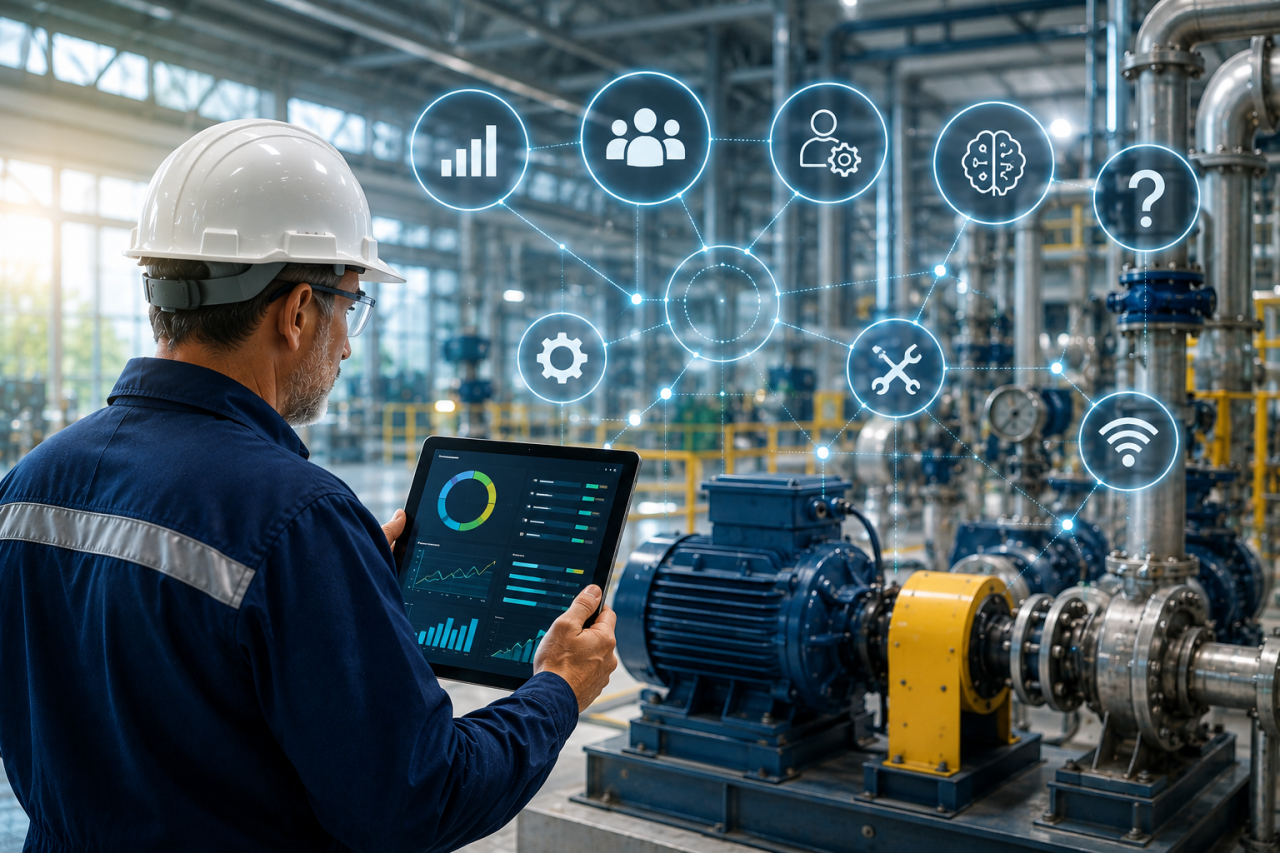
Intelligent Asset Management reflects a simple reality: the best operational outcomes happen when human expertise and embedded AI work together.
Maintenance professionals bring judgment, context, experience, and practical understanding. AI brings speed, pattern recognition, scalability, and the ability to work with large volumes of operational data.
Together, they create a system that helps organizations improve decision-making, reduce risk, accelerate learning, and strengthen operational performance.
This is not about replacing people.
It is about extending their capability.
When intelligence is embedded directly into everyday workflows, organizations can do more with the expertise they already have. Knowledge becomes easier to preserve. Decisions become easier to scale. Routine work becomes easier to reduce. Teams can spend more time on the work that requires judgment, safety awareness, and operational experience.
That is where asset management is heading: not toward more software for its own sake, but toward more intelligent ways of working.
Focus Will Matter More Than Ever
As enterprise software markets consolidate, industrial organizations need a clear way to evaluate what matters most.
Will their asset management partner remain focused on maintenance, reliability, safety, and operational performance?
Will innovation continue to reflect the realities of asset-intensive environments?
Will new capabilities help teams work more effectively without forcing disruptive change?
Will AI be embedded where work happens, or added as another disconnected layer?
Operational excellence requires more than technology. It requires domain expertise, practical implementation, and a partner that understands how maintenance and operations teams actually work.
Because when performance, risk, and resilience are the objectives, focus matters.
Intelligence Will Define the Next Decade
The organizations best positioned for the next decade will not simply operate more assets. They will operate with better visibility, faster decision-making, and stronger knowledge retention across maintenance, reliability, and operations teams.
They will combine human expertise with embedded AI capabilities that support better decisions, reduce manual effort, preserve operational knowledge, and create greater resilience across the enterprise.
Industry consolidation may reshape vendors.
But intelligence will reshape operations.
That is the transformation that matters most.
At Ultimo, we believe Intelligent Asset Management represents the next evolution of enterprise asset management: helping industrial organizations combine the judgment of their best people with embedded AI that supports better decisions, reduces manual effort, and improves operational performance over time.
Because the future will not be defined by who owns the most software.
It will be defined by who helps organizations achieve more with the people, assets, and knowledge they already have.