
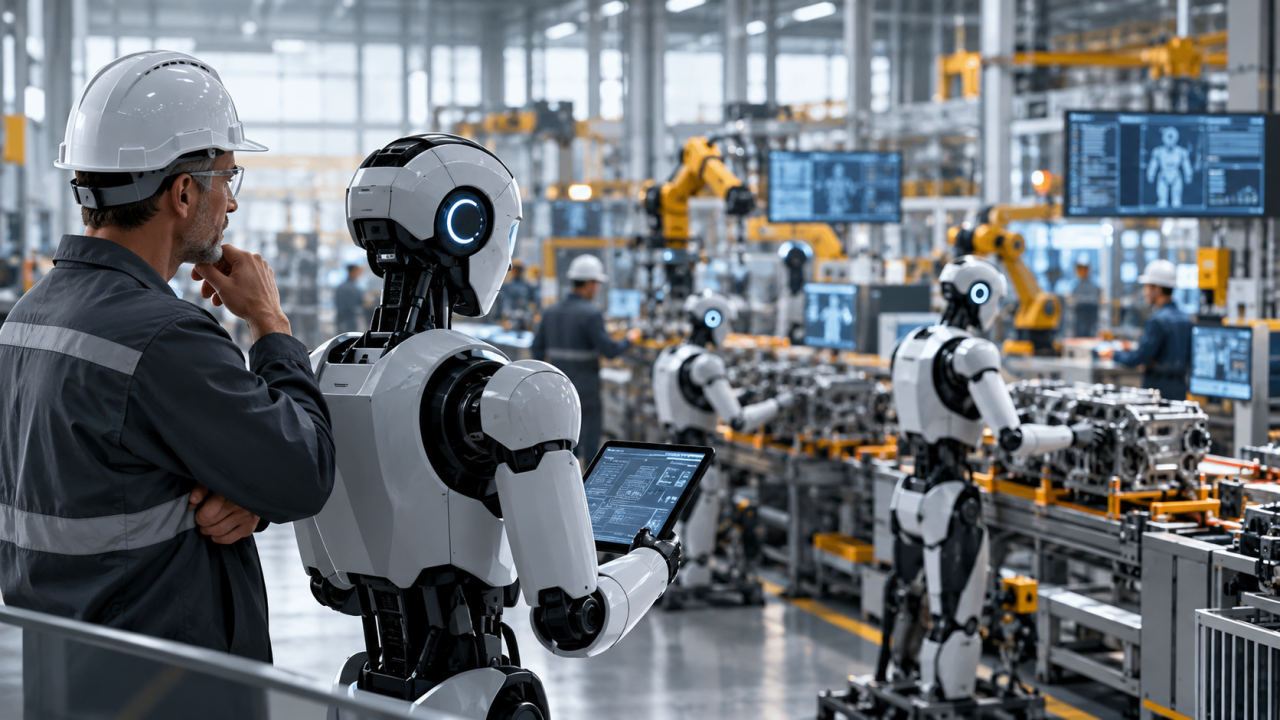
Every plant has someone like this. They can walk past a line, hear something slightly off, and tell you which bearing is about to go before any sensor notices. They've been there 25 years, maybe more. And there's a good chance they are nearing retirement.
Manufacturing's next chapter depends on what happens to everything that person knows.
Where we left off
In our Five Predictions for Manufacturing in 2026, we said digital labor would become a trusted junior coworker, absorbing knowledge from retiring engineers. We predicted leading manufacturers could automate 40 to 60 percent of routine maintenance tasks end to end, that maintenance planning and supply chain strategy would become tightly intertwined, and that carbon and energy efficiency would become core criteria in repair-or-replace decisions.
Our 2026 predictions were mostly about capability. For 2027, we want to talk about accountability. Who owns the AI, what it saved, and who's still on the plant floor at 2 a.m. when something breaks.
1. Digital labor gets a performance review
At Ultimo, we've taken our own advice. We have around 30 digital workers on our org chart, each with a job title, a digital profile, and a human manager who reviews its performance every month. One of them, a legal assistant called Contract IQ, answered 46 questions in its first month with an average response time of two minutes, and only two needed human follow-ups.
The numbers are impressive, but the review process is what makes them last. A digital worker without an owner doesn't get better. Nobody notices when its output drifts, and nobody feeds back what it got wrong.
In 2027, we expect manufacturers to apply the same discipline to maintenance. A digital planner that prepares work packages will be reviewed on hours saved, accuracy of parts lists, and how often technicians override its recommendations. Those reviews will become the evidence for expanding AI across sites, or for retiring what isn't working.
2. Reshoring will be won or lost in the maintenance shop
Production is coming home, at least partly. According to the Reshoring Initiative, 36 percent of OEMs say they reshored or are actively reshoring in 2026, up from 29 percent in 2025, with tariffs, geopolitical risk, and proximity to customers cited as the top reasons.
Building the plant is only the start. The same Reshoring Initiative survey found that shortages of skilled workers, along with policy uncertainty and import price competition, are slowing the pace of reshoring. And Deloitte and The Manufacturing Institute estimate US manufacturing could need up to 3.8 million new workers by 2033, with as many as 1.9 million of those jobs at risk of going unfilled.
You can reshore a factory, but you can't reshore 30 years of maintenance know-how. Our prediction: in 2027, reshoring's success will depend as much on whether new plants are maintainable from day one as on tariff policy. That means a clean asset register at commissioning, documented procedures, and a realistic plan for who will keep the equipment running.
3. The boring data problem finally gets the attention it deserves
Ask a plant manager for a complete list of their assets, with locations and current condition, and watch the pause. As our Chief Product Officer Harmjan Derksen has written in Forbes, incomplete maintenance records, inconsistent asset hierarchies, and failure codes used differently from site to site are real problems in almost every industrial operation.
AI can't fix what it can't see. In 2027, we expect leading manufacturers to fund asset visibility as seriously as AI itself, and to use AI to speed up progress. Data gets better fastest when AI is working with it, flagging gaps and feeding structured records back into the system.
4. Knowledge loss becomes a risk you measure
In our Maintenance Trend Report, 63 percent of maintenance professionals named the aging workforce as the most pressing trend affecting their maintenance strategy. For many plants, that's already showing up shift by shift.
Our own data shows how much this matters. Across Ultimo's cloud customers, mean time to repair peaked in 2022, at the end of a three-year stretch marked by workforce shortages and supply chain delays. Since then, it has fallen 42 percent, based on 6.9 million tracked failures, and the decline continued after we made embedded AI available to all new customers in January 2025. Three in four customers who were with us across 2024 and 2025 saw their repair times go down.
Harmjan makes a point we think will define 2027. That the quality of a shift is a function of who's on it. Most of the attention goes to what AI can do for your best engineer. The bigger payoff is raising the floor for the least experienced technician on the thinnest night shift, giving them the history, procedures, and context that used to live in someone else's head.
That only works if the knowledge is captured in the first place. So, we expect more manufacturers to spend 2027 mapping and documenting their maintenance processes, rather than just training staff to write better AI prompts. Process knowledge must exist somewhere before any system, human or digital, can use it. Encoding this tribal knowledge assures it is machine readable - not just logging and capturing the knowledge but doing so in a way that today's models can work with it - and tomorrow's models can amplify it to unprecedented levels.
What to do now
Start with an honest baseline. Our EAM Maturity Model helps manufacturers see where they stand and what to prioritize first. For the data behind these predictions, download the Ultimo Maintenance Trend Report, and read Harmjan's piece, Why The Industrial Maintenance Crisis Is A Math Problem.
