
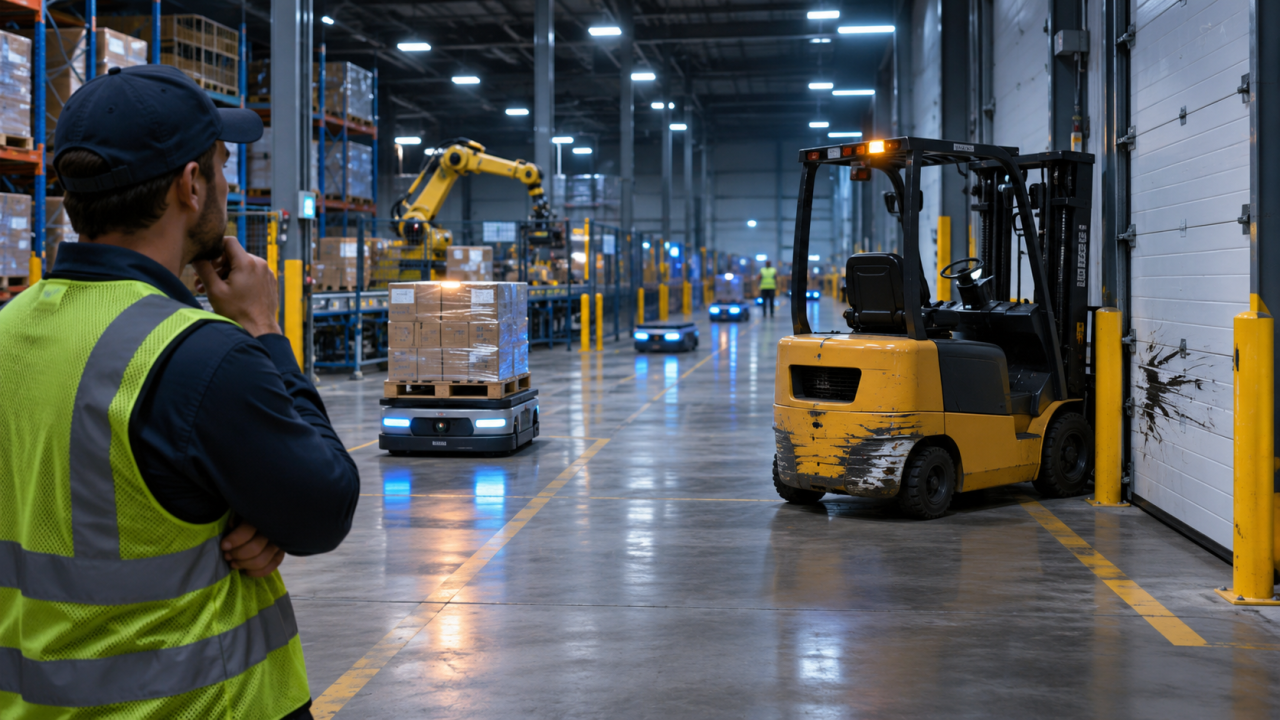
It's the end of a night shift at a distribution center. A few hours ago, a forklift clipped a dock door. Nobody was hurt. The driver mentioned it to a colleague and fully meant to report it. Then the shift ended, and the moment passed.
Multiply that by every site, every shift, every year, and you get a sense of how much operational reality never makes it into a system. In 2027, this will matter as much as any new technology when it comes to closing that gap.
Where we left off
In our Four Predictions for Logistics in 2026, we predicted fleet-wide predictive maintenance working alongside dynamic routing, self-diagnosing vehicles and robots in last-mile operations, real-time asset visibility across ports, distribution centers, and airports, and maintenance strategies reshaped by fleet electrification.
Plenty of that is now in motion. But as automation scales, a new set of questions is surfacing. Who is responsible for maintaining all this equipment? Who owns its uptime? And what happens to the spare parts strategy when trade rules keep changing?
1. Automation will outpace the people trained to maintain it
Warehouses are filling with sortation systems, conveyors, autonomous mobile robots, and automated storage. While each one makes the operation faster, each one also requires someone who knows how to keep it running.
That's becoming a real constraint. In Modern Materials Handling's 2026 MRO Survey, around seven in ten warehouse and distribution center operators reported a current shortfall of automation technicians, and 52 percent said finding technicians with the right skills was their biggest hiring challenge, up from 44 percent a year earlier. And it's not only warehouses hiring. As manufacturers bring production back to the US, they're competing for many of the same mechanical and electrical skills.
Our prediction is that the operators that pull ahead in 2027 will be those that keep their equipment running with the team they have. That means enabling every technician on the technology that gives them fast access to equipment history, fault patterns, and the fixes that worked last time.
2. Every autonomous asset will get a named owner
In 2026, the story was self-diagnosing vehicles and robots. In 2027, it becomes accountability.
When a fleet of autonomous robots goes down, it's often unclear whose problem it is. The vendor's? The site maintenance team’s? IT's? We expect leading operators to settle that question explicitly, with a named team or a named digital worker responsible for each fleet's uptime, and a human manager reviewing its performance regularly.
At Ultimo, we manage our own digital workers this way, with job titles, human managers, and monthly reviews. It might sound like an HR exercise. In practice, it's how you make sure someone notices when performance drifts, and that lessons feed back into how the system works.
3. Spare parts move from the stockroom to the strategy meeting
Tariffs on metals and vehicle parts and a trade regime that has changed several times in 2026 are making imported goods and parts harder to price and plan for. That turns the spare parts inventory into a strategic question: what do you hold, where do you hold it, and how much risk are you carrying if a critical part takes weeks to arrive?
The upside is that better inventory management pays off quickly. Carrying costs for spare parts (the capital tied up, the storage space, the risk of obsolescence) adds up fast, and stock decisions based on habit rather than data tend to get it wrong in both directions: too much of what you don't need, too little of what you do. In 2027, we expect more logistics operators to link maintenance planning directly to parts inventory, so stock decisions are driven by actual asset condition and failure history.
4. Safety reporting will stop depending on memory
Back to that dock door. Ultimo's HSE digital worker was built for exactly this kind of moment. It reads work orders, spots incidents that probably should have been reported, like a door dented by a forklift, and drafts a safety report for a human to review.
On busy sites, minor incidents and near-misses often go unrecorded because people are tired, rushed, or because the reporting infrastructure is overly complicated. Yet near misses are where the early warning signs live. In 2027, we expect automated incident capture to become standard practice in large logistics operations. People will still make the decisions, but they'll no longer rely on memory to raise the flag.
The electrification checkpoint
In 2026, we predicted fleet electrification would reshape logistics maintenance. In the US, the ground has shifted since then. The federal commercial clean vehicle credit ended for vehicles acquired after September 30, 2025, and ACT Research now expects zero-emission commercial vehicle adoption to be gradual rather than sudden. That makes 2027 a different kind of checkpoint. Without federal incentives doing the heavy lifting, every electric vehicle must justify itself on uptime and total cost of ownership. For most operators, that means running mixed fleets of diesel and electric vehicles for years, each with different failure patterns, maintenance schedules, and skill requirements. The operators who track performance across both will know exactly where electrification pays off, and where it doesn't.
What to do now
To see where your maintenance operation stands, start with our EAM Maturity Model. For wider data on workforce, AI, and maintenance strategy, download the Ultimo Maintenance Trend Report. And for the bigger picture on AI agents joining the industrial workforce, read What the Work Trend Index Means for Industrial Leaders in 2026.
