
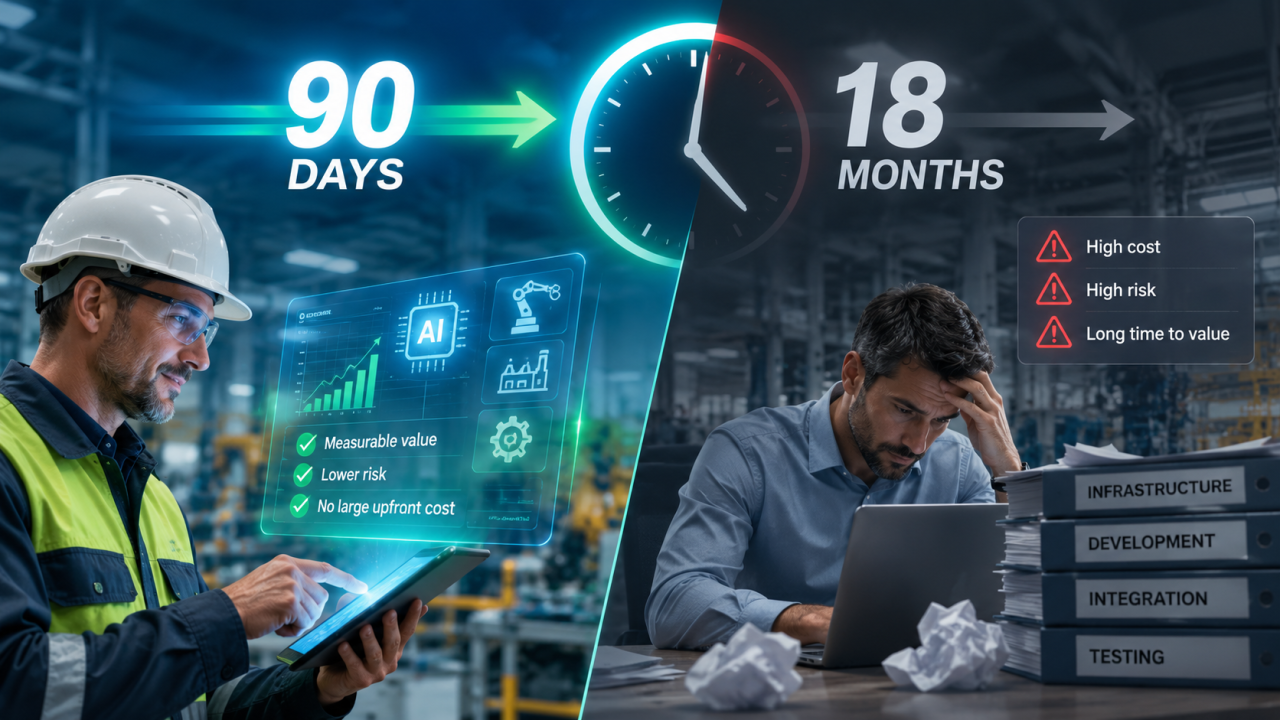
When I speak with maintenance and operations leaders about AI, the conversation almost always arrives at the same point. They understand the opportunity. They feel the urgency. And then they describe a timeline that makes the whole thing feel impossibly far away.
Building a robust AI solution in-house, they tell me, is an 18-month project. Sometimes longer. There is the data preparation, the integration work, the security review, the change management, the compliance requirements. By the time they have worked through the list, the enthusiasm that started the conversation has quietly deflated.
What I find interesting is how rarely the same leaders consider that the 18-month timeline is not a fact about AI. It is a fact about building.
And building is not the only option.
Where the time goes
The 18-month figure is not an exaggeration. McKinsey and the Standish Group's 2024 CHAOS Report found that large custom IT projects routinely run 45 percent over budget and deliver 56 percent less value than originally planned. External consultants typically deliver equivalent solutions five to seven months faster than in-house teams, who often require nine to eighteen months just to reach a working deployment. More than a third of large custom software initiatives are abandoned before they get there.
The time does not go on the AI itself. It goes on everything surrounding it. Assembling and cleaning operational data. Building integrations with existing enterprise resource planning (ERP) and maintenance systems. Designing governance frameworks that will hold up under audit. Training the model on domain-specific context that took years to accumulate in the first place. Navigating internal approval cycles that no one anticipated at the start.
Each of those steps is necessary. None of them are shortcuts. And each one is a step that a purpose-built platform, embedded in industrial operations across hundreds of customer deployments, has already taken.
What 90 days means
At Ultimo, we talk about 90 days from decision to operational value. I want to be precise about what that means, because it is a specific claim and it deserves a specific explanation.
It does not mean 90 days to a demo. It means 90 days to a proven use case, running against a real agreed metric, in a live operational environment. One agent, one problem, one measurable outcome. Not a prototype and not a proof of concept, but a result.
The reason that timeline is achievable is not speed for its own sake. It is because the foundational work has already been done. The operational context, the asset hierarchies, the maintenance workflow logic, the domain knowledge accumulated across years of real industrial deployments, is already embedded in the platform. The integration framework already exists. The governance architecture is already built. What remains is configuring the solution to your environment and your specific problem, which is a fundamentally different task from building from scratch.
This is the head start that is genuinely difficult to replicate in an in-house build, regardless of how talented the team is.
The cost of waiting
There is a number I come back to often in these conversations. Siemens' 2024 research estimated that unplanned downtime costs the world's 500 largest industrial companies $1.4 trillion every year. The average large plant experiences around 27 hours of unplanned downtime per month.
Those numbers make the timeline question feel different. An 18-month build is not just a project plan. It is 18 months of operating without the maintenance intelligence your competitors may already have. It is 18 months of your most experienced engineers carrying knowledge that is not yet captured, structured, or accessible to the people who need it most. It is 18 months of planning meetings that take longer than they should, work orders that go out incomplete, and failure history that exists in the system but is too difficult to retrieve to be useful in the moment.
The opportunity cost of a long build is real, and it is ongoing. Every month the system is not in production is a month the operation is not improving.
The cost that rarely appears on the project plan yet is the one that tends to surface last relates to what happens to the people doing the building. An internal AI project does not just consume budget and calendar time. It consumes the attention of your best engineers and continuous improvement specialists - the people whose expertise is most valuable when applied to the operation itself.
Once a build project reaches production, those people do not move on. They become the owners of a software product they never set out to run, maintaining it indefinitely, fielding complaints from operators on other shifts, troubleshooting integrations at times that were never in anyone's job description. There is no SLA. There is no support team. There is, in most cases, a single person whose departure would leave the organization unable to explain, fix, or replace the system the plant now depends on. That is not a technology risk. It is a people risk, and it compounds with every month the system stays in production.
One use case, one metric, one shift
The practical implication of a 90-day path to value is that the decision to start does not have to carry the weight of a full transformation program. That is one of the most important things about it.
Industrial AI does not have to be deployed everywhere at once to be worth deploying. It can start with the problem that is most expensive and most tractable - the morning stand-up that takes an hour to prepare, the failure diagnoses that send technicians back twice, the safety signals that disappear into a maintenance work order before anyone logs them. One agent, proving one result, against one agreed metric.
Stefan van Bussel at Berkvens Doorsystems describes it well. Their maintenance planner agent now saves each team lead between 30 and 60 minutes every morning and matches their manual analysis at over 95 percent accuracy. That result was not the product of a long build. It was the product of a clear problem, a platform with the operational context already in place, and a team focused on one outcome.
That is what a 90-day alternative looks like in practice. Not a compressed version of an 18-month project, but a fundamentally different way of approaching the question.
The question worth asking first
For most industrial organizations facing real pressure on downtime, workforce capacity, and operational performance, the path that is becoming clearer every month is not a choice between building and buying in the traditional sense. What a purpose-built platform offers is the scaffolding - the strong operational foundation, the data infrastructure, the governance architecture, the domain knowledge accumulated across hundreds of deployments - on top of which your team can configure, adapt, and extend for your specific environment and problems.
You are not trading control for convenience. You are choosing where to apply your team's expertise - maintaining infrastructure, or on improving the operation. For most industrial organizations right now, that distinction is the decision.