
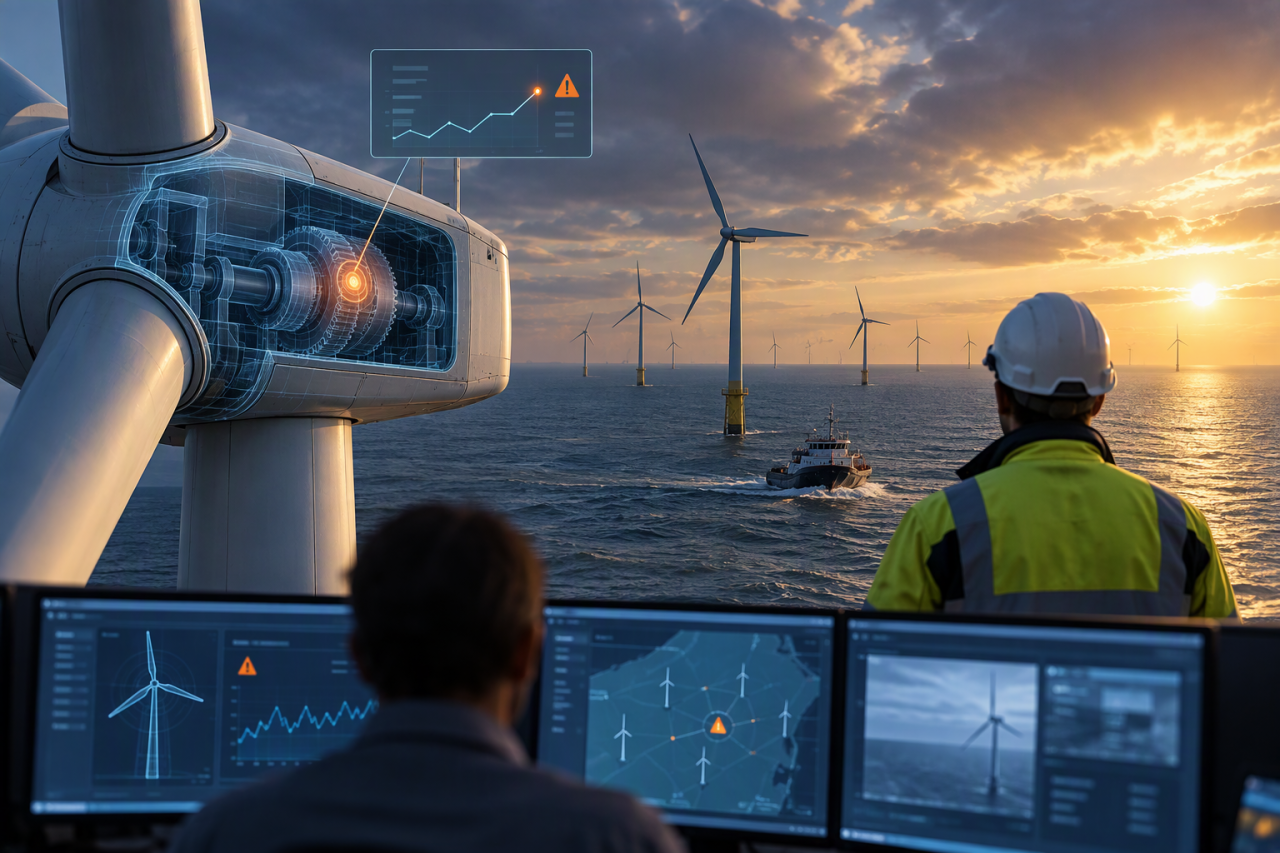
Somewhere tonight, a gearbox in a wind turbine is running a few degrees warmer than it did last month. At more sites, a model has probably noticed. The question that will define energy maintenance in 2027 is what happens next. Who sees the alert, who decides it matters, and who signs off on sending a crew 40 miles offshore when the weather window is marginal?
Where we left off
In our 2026 predictions for energy, we focused on what technology would make possible, such as AI forecasting failures months in advance, digital twins of plants and substations, drone inspections of offshore wind farms cutting costly vessel trips by up to 30 percent, and cybersecurity built into every maintenance activity.
Some of that is already in the field. Where it is, energy organizations are increasingly looking for answers on how AI will be managed, who will pay for it, and who owns the result.
1. Every AI agent will get a job title, and a manager
Through 2027, the leading operators will stop treating AI as a feature they switch on and start treating it as labor they manage.
That sounds abstract until you see it in practice. At Ultimo, we've put around 30 digital workers on our own org chart, each with a job title and a human manager who reviews its work continuously. Tools without owners don't improve, they stagnate.
Picture a digital worker responsible for turbine health across a wind portfolio. It watches vibration and temperature data around the clock, drafts work orders, and flags issues. Once a month, a reliability engineer reviews its calls - which alerts were right, which were noise, and what it missed. That review loop is what turns a promising model into one people trust at 2 a.m.
We launched our own digital workers for maintenance planning, technicians, and safety this year. In our view, the management model around them will matter as much as the technology inside them.
2. Tighter capital will make "repair, refurbish, or retire" the decision of the year
After years of rapid growth, energy investment is cooling. Wood Mackenzie forecasts global energy and natural resources investment will dip around 4 percent in 2026, to roughly $1.58 trillion, after climbing 41 percent since 2020. When capital tightens, the assets you already own must work harder and last longer.
That puts the repair-or-replace decision under a brighter light than ever. In 2026, we predicted carbon intensity would become an input into refurbish-or-retire choices. In 2027, we expect finance teams to ask maintenance leaders to defend those decisions in auditable terms: expected remaining life, risk of failure, cost of downtime, and carbon impact, side by side.
Operators who can answer quickly will win the budget arguments. Those still pulling numbers from three systems and a spreadsheet will struggle.
In the US, those arguments are about to get harder. Demand is climbing fast. EPRI estimates data centers could consume 9 to 17 percent of US electricity generation by 2030, more than double today's share. Much of the infrastructure carrying that load is already well into its working life, with 70 percent of US transmission lines and power transformers more than 25 years old.
Federal policy has shifted too. Under the One Big Beautiful Bill Act, wind and solar projects that didn't begin construction by July 4, 2026, must be in service by the end of 2027 to qualify for federal tax credits. That leaves maintenance teams with two jobs at once in 2027 - bringing a wave of deadline-driven new assets into service and keeping an aging grid running harder than it was ever designed to. Every hour spent reconciling spreadsheets is an hour not spent on either.
3. The most valuable data in energy will be the data nobody wrote down
Ask any maintenance director what keeps them up at night, and the aging workforce comes up fast. In our own Maintenance Trend Report, 63 percent of maintenance professionals named the aging workforce as the most pressing trend affecting their maintenance strategy.
The risk goes beyond headcount. It's everything an experienced technician knows that never made it into a work order: the sound a failing bearing makes, the fault pattern that never shows up in a manual, or the fastest way to restart production line one. When that person retires, the knowledge leaves with them unless someone has deliberately captured it.
In 2027, we expect knowledge capture to move from an HR initiative to an operational priority with its own budget line. The best approaches will be practical. Technicians will record findings by voice at the point of work and new hires will get answers from that history instead of waiting for the one person who knows.
4. Safety reporting will stop depending on memory
Cyber-physical security was one of our 2026 predictions, and it remains critical. But there's a quieter safety story we think will matter just as much in 2027 - near-miss reporting.
Most near-misses go unreported for a simple reason. Someone tired, at the end of a long shift, forgets or decides it isn't worth the paperwork. AI that reads work orders and shift logs can spot incidents that should have been logged and draft the report for a human to review. In an industry where small warning signs often come before serious incidents, that capability protects people, not just productivity.
What this means for 2027
The common thread is accountability. Energy operators have largely stopped asking whether AI works in maintenance. In 2027, they'll ask whether it has an owner, whether it can show its value in terms the CFO accepts, and whether it makes each shift safer and smarter than the last.
To see where your organization stands, our EAM Maturity Model is a practical place to start. For a broader view of the forces shaping maintenance, read the full Ultimo Maintenance Trend Report.
