
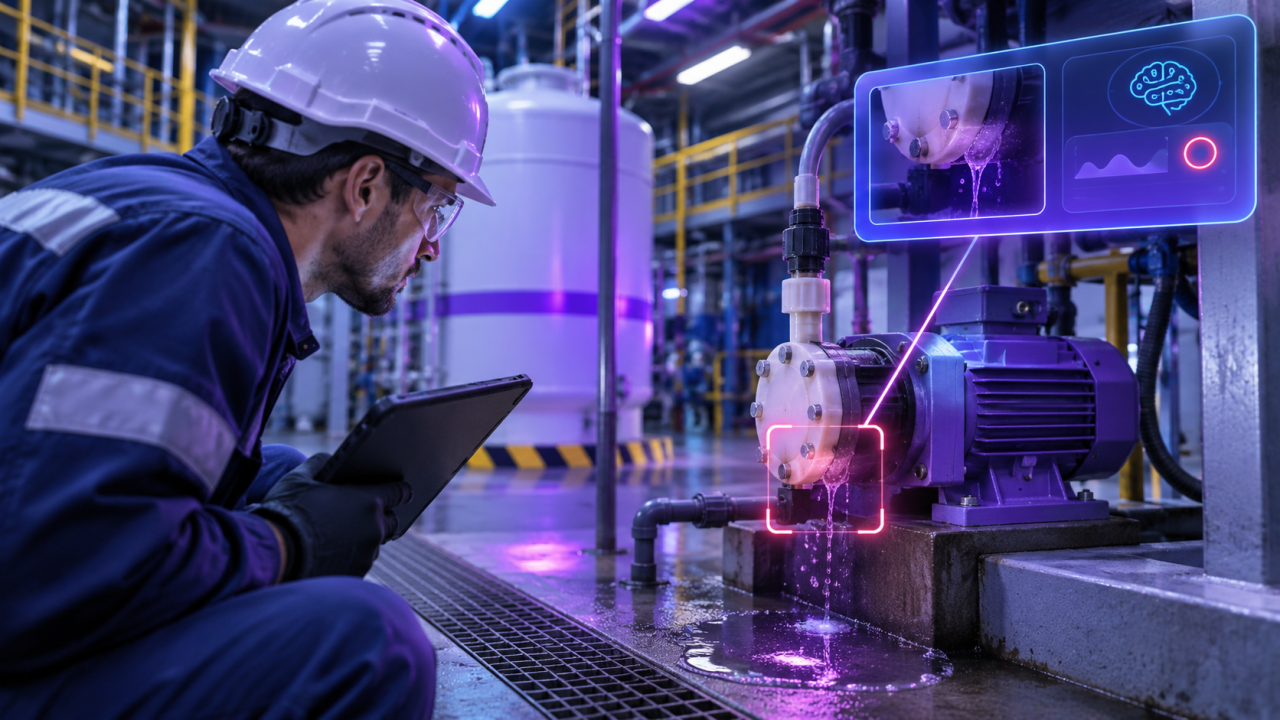
The repair is on record. The hazard isn’t. Nobody logs that a corrosive chemical sat on a walkway for an unknown number of hours, where someone could have slipped in it or splashed it into their eyes. The information exists, in a maintenance note. It just never reaches the safety team.
That’s what AI changes. An AI digital worker can read every closed work order and pick up what a busy technician didn’t flag: a leak of a hazardous substance, a near miss mentioned in passing, a repair that points to a wider risk. It doesn’t make the call itself. It raises a possible incident for the safety team to review, with the work order attached.
On October 31, CNBC asked a blunt question: AI is coming to construction sites. But does it make workers safer? Our CEO, Steven Elsham, was one of the people they spoke to. The honest answer is more interesting than a simple yes.
Does AI make workers safer?
Not proven, at least not yet. AI is already cutting paperwork, flagging hazards and improving planning on construction sites, roads, railways and utilities. But researchers told CNBC that the evidence it directly prevents injuries is still limited.
Most studies so far have measured productivity. They tend to assume that if AI reduces how long people are exposed to hazards, risk falls too. That's a reasonable assumption. It just hasn't been proven.
The headline numbers don't settle it either. In Britain, construction deaths fell to 25 in 2025/26, down from 35 the year before and below the five-year average of 37. Good news, but researchers point out that a slower economy may explain part of the drop.
We think that caution is healthy. If you're investing in AI for safety, you deserve evidence, not just a vendor's promise.
Why it matters so much in the US
In 2024, 437 people working in installation, maintenance and repair occupations died from work-related injuries in the United States, according to the Bureau of Labor Statistics. Their fatal injury rate was 8.9 per 100,000 full-time equivalent workers, nearly three times the 3.3 average across all US workers. These are the people doing the work this article is about: fixing pumps, replacing seals, working on and around equipment that’s still live. And behind every recorded fatality are many more incidents and near misses that never made it into a report.
Falls, slips and trips remain the biggest killer, responsible for 389 of those deaths. The numbers are moving in the right direction, but slowly. And behind every fatality sit many more near misses and unsafe conditions that went unrecorded.
That's where the real opportunity lies.
Where AI already helps: the incidents nobody writes down
Traditional safety management runs on manual reporting. Someone must stop, find the form and log what happened. Often, there isn’t time to stop. Busy people forget. Some decide a near miss isn't worth the hassle. Others worry about getting a colleague in trouble.
The result is a blind spot. You can't fix a hazard you don't know about.
This is the problem Steven raised with CNBC: AI can flag safety incidents that would otherwise go unreported. It's also why we built Ultimo's EHS (environment, health and safety) agent. It reads the work order requests and shift logs already flowing through the system and identifies the ones that describe a safety incident, then reports them automatically.
Think back to that dosing pump. The technician did everything right on the maintenance side: he found the fault, fixed it and closed the work order. He just didn’t think of the spill as a safety event, so he never filled in an incident form.
The agent reads that work order and recognizes what’s in it: a corrosive chemical, on a walkway, for an unknown length of time. It raises a possible near miss for the safety team, with the work order attached, and a person decides whether it counts as an incident. Now it can be tracked and investigated. Why did the seal fail? How long was the leak there? Does that pump need a drip tray, or a shorter inspection interval? Answering questions like these is how the next incident gets prevented.
More data isn't the same as more safety
There's a catch, and CNBC's article named it. Keeping a human in the loop only works if that human can keep up. If AI produces more alerts than a supervisor can realistically review, you haven't removed a blind spot. You've buried it under noise.
That's why we don't think of AI agents as replacements for safety professionals. We think of them as digital apprentices. You start them on narrow, well-defined tasks. Experts check their work, correct them and give feedback, so their suggestions get better over time. Responsibility grows as trust is earned.
In practice, that means an agent should make a safety team's job easier, not longer. It should surface the incidents that matter and leave the judgment calls to the people who know the site.
Spend the time AI saves on safety, not just output
AI saves time. That part isn't in doubt. The real question is what you do with it.
The tempting answer is to squeeze more jobs out of every worker. Steven's view, as he told CNBC, is that companies should reinvest those hours in safety, first-time fixes and reliability instead.
On a site, the equivalent might be an extra walkthrough before a high-risk job, more time to do a repair properly the first time, or a real conversation about the near miss everyone shrugged off.
How to tell if your AI safety tools are working
If the research evidence is still thin, build your own. Here's where we'd start:
Set a baseline before you switch anything on. Record how many incidents, near misses and unsafe conditions you log each month today, and how long they take to close.
Watch leading indicators, not just injuries. Serious injuries are, thankfully, rare enough that they move slowly. Near-miss reporting rates, time to resolve a hazard and repeat incidents tell you much sooner whether something has changed.
Give every AI worker a human owner. Someone should be accountable for how well it performs and for acting on what it finds. Tools without owners stagnate.
Review it like a team member. Check monthly what the agent caught, what it missed and what it got wrong, and feed that back.
Decide where the saved time goes. Write it down. If nobody decides, it will quietly turn into more output.
The bottom line
AI won't make a site safer on its own. What it can do, today, is shine a light on the incidents that never get reported and hand people back time. Whether that leads to fewer injuries depends on the people who own the tools and the choices they make with what the tools reveal.
That spill should never have ended as half a sentence in a maintenance note. It should have been a logged near miss, an investigated cause and a closed loop.
Frequently asked questions
Does AI reduce injuries on construction sites? Researchers say there isn't yet strong evidence that AI directly prevents workplace injuries. Most studies have measured productivity, on the assumption that less exposure to hazards means less risk.
How can AI improve safety reporting? AI can identify safety incidents in information workers already create, such as maintenance work order requests, and log them automatically. That reduces the number of near misses and unsafe conditions that go unreported.
Will AI replace safety managers? No. AI agents work best as digital co-workers that handle routine detection and logging, while experienced people review the findings, make the judgment calls and act on them.
What is Ultimo's EHS agent? It is an AI agent within Ultimo's enterprise asset management platform that autonomously identifies and logs safety incidents based on the work order requests already in the system.
Try this tomorrow morning. Pull last month’s maintenance work orders and count how many describe a safety issue: a loose rail, a leak, a damaged guard. Then check how many of those became incident reports. If the gap surprises you, you’re not alone. Ultimo’s AI-augmented enterprise asset management software supports an EHS agent that finds those incidents for you.
