
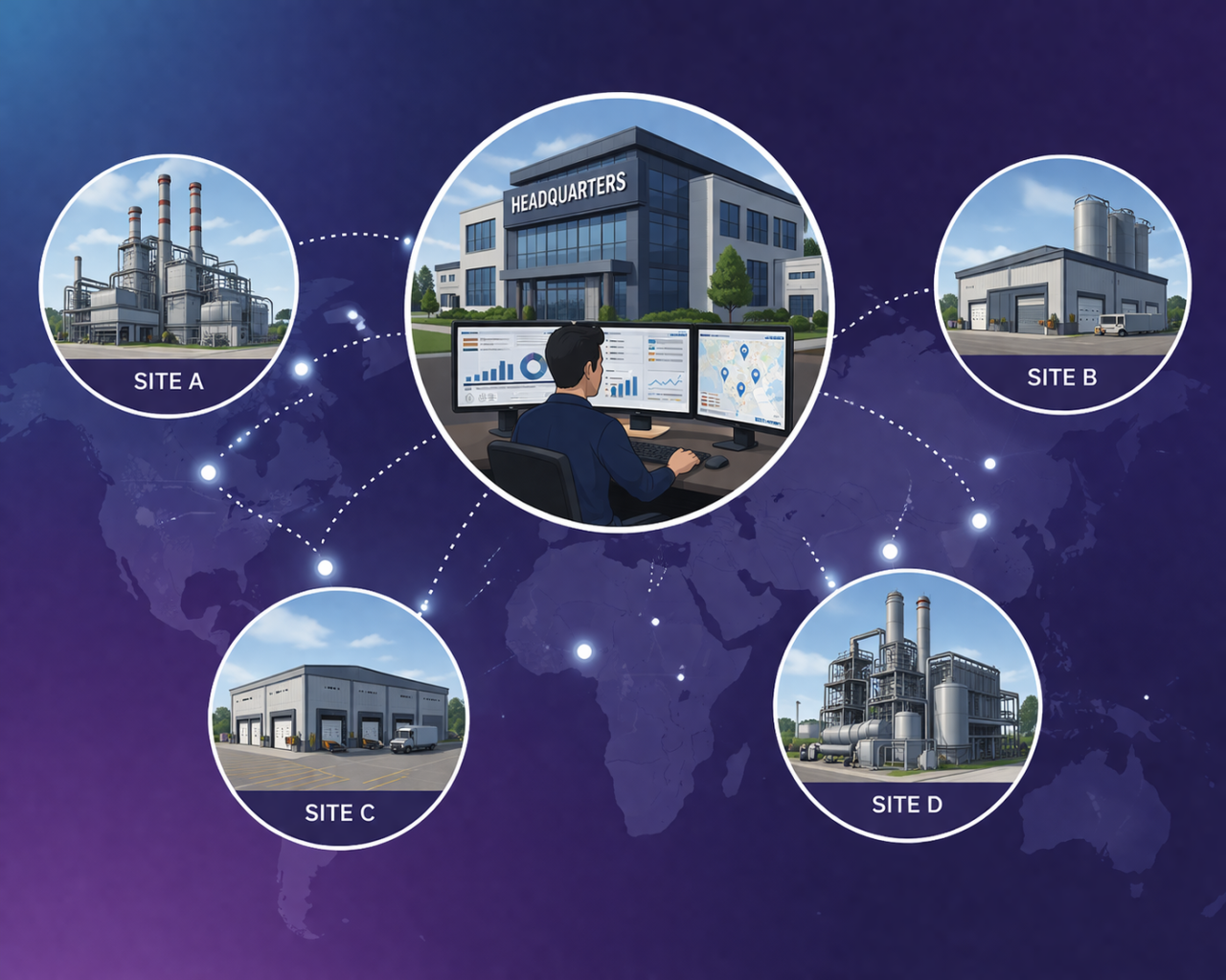
Managing maintenance across multiple sites has never been simple. But in 2026, the complexity has quietly multiplied. Our latest North America–specific survey data reveals a landscape where leaders are coordinating tasks across locations - but they're navigating wildly different maturity levels, asset profiles, workforce capabilities, and system limitations at each site.
This isn't just operational complexity. It's strategic complexity. And it's reshaping how organizations think about maintenance, reliability, and the role of modern enterprise asset management (EAM).
What often gets overlooked in that conversation? Change management. Because even the best strategy fails if the people, processes, and culture aren't brought along with it.
Multi-Site Operations: A Challenge of Variation, Not Volume
When we asked North American respondents how many production or operational sites fall under their responsibility, the distribution was strikingly broad. This spread tells us something important: multi-site maintenance isn't a niche challenge - it's the norm. And the more sites an organization manages, the more variation they must absorb.
Maintenance leaders today are asked to deliver more with fewer hands, while adapting to forces far beyond their control. Multi-site operations amplify that pressure. And every time a new process, tool, or standard is introduced across sites, there's a change management challenge waiting on the other side.
1. Every site has a different maturity level
Our survey shows maintenance strategies ranging from primarily reactive to asset performance driven, with no single approach dominating. That means a leader overseeing 10 sites may be managing:
A predictive maintenance pilot at one site
A backlog-heavy, reactive environment at another
A compliance-driven operation at a third.
This fragmentation makes standardization difficult and progress uneven. But the deeper challenge is behavioral: getting teams at different maturity levels to adopt the same direction requires active change management, not just a new rollout plan. Leaders need to meet each site where it is, build local buy-in, and create a path forward that feels achievable, not imposed.
2. Asset portfolios vary dramatically
Respondents reported responsibility for a mix of assets that includes production machinery, safety-critical assets, facilities, utilities & infrastructure, mobile equipment, tooling, molds, and dies.
A multisite leader may be juggling a food plant with strict safety-critical requirements, a distribution center with heavy mobile equipment, and a manufacturing site with aging production lines. Each asset type brings its own regulatory, operational, and maintenance demands - and each demands that site teams understand why new processes exist, not just what to do. Clear communication of intent is a change management fundamental that pays dividends here.
3. Workforce capability differs by location
Skilled labor shortages were one of the most frequently selected challenges in the survey. But shortages aren't evenly distributed. Some sites have seasoned technicians; others rely heavily on contractors or new hires.
The future of maintenance may be enabled by AI, but it will still be guided by people. That means change management isn't a one-time project kick-off - it's an ongoing commitment. Multi-site leaders must invest in training, role clarity, and consistent reinforcement across multiple labor markets. When a new hire in one city and a 20-year veteran in another are both expected to follow the same workflow, the system and the change approach both need to work for them.
4. Technology adoption is inconsistent
Even within the same company, EAM/CMMS usage varies widely. Respondents reported uneven adoption of mobile maintenance, reporting & dashboards, asset hierarchy & history, spare parts management, and regulatory compliance tracking.
The top system shortcomings cited were:
Limited reporting or decision insights
AI capability gaps
Vendor support or roadmap concerns
Weak mobile experience.
If one site uses mobile-first workflows and another still relies on paper, leaders can't compare performance or scale improvements. But technology gaps are often a symptom of a change management gap. When people don't trust, understand, or see value in a system, adoption stalls. Closing that gap requires more than a better tool. It requires a deliberate effort to show people what's in it for them.
5. Integration challenges multiply across sites
Poor integration with ERP/MES/OT was brought into sharp focus by survey respondents. But in multi-site environments, the challenge compounds. Different sites may use different ERP versions, MES maturity varies, OT connectivity is inconsistent, and data quality differs dramatically.
This creates a fragmented data landscape that undermines visibility and decision-making. And when data can't be trusted, people revert to workarounds - spreadsheets, tribal knowledge, informal processes. Breaking that cycle is as much a people problem as a technology one.
The Real Hidden Complexity: You're Managing Multiple Realities
Multi-site maintenance isn't just about coordinating work across locations. It's about managing multiple operational realities at once - different asset types, maintenance cultures, digital maturity levels, workforce capabilities, regulatory pressures, and data quality baselines.
This is why no single challenge dominates the North American market, and why multi-site leaders often feel like they're solving a puzzle with pieces from different boxes.
Picking the right EAM strategy is essential. But it's only half the battle.
So, You've Chosen the Right Strategy. Now What?
This is the question we hear most often from customers - and it's the right one to ask.
The most common reason maintenance transformations stall isn't technology. It's change management. New systems get implemented. Workflows get designed. And then... adoption plateaus. Technicians revert to old habits. Managers struggle to get consistent data. The return on investment (ROI) stays on the slide deck instead of showing up in the numbers.
Here's how leading organizations make change stick across multiple sites:
Assign change champions at the site level. Central leadership can set direction, but local champions drive adoption. Identify respected technicians and supervisors who understand both the operational reality and the new way of working and empower them to lead it
Make the system easy to use, and hard to avoid. Change management isn't just communication and training. It's design. If the EAM system is intuitive, mobile-first, and reduces friction for the people using it daily, adoption follows naturally. If it creates more work, it will be resisted, regardless of how many emails get sent
Measure behavior, not just outcomes. Track adoption metrics - work orders completed digitally, PM compliance rates, data completeness - alongside lagging indicators like downtime and cost. Early behavioral signals tell you where change is taking hold and where it needs reinforcement
Build a continuous improvement loop. Change management isn't a project with an end date. As sites mature, new capabilities get introduced, and new people join, the work continues. Organizations that treat it as ongoing - with regular review, feedback cycles, and recalibration - sustain momentum far longer than those who treat it as a one-time initiative.
Every multi-site organization has a unique complexity profile. The question isn't whether you have complexity - it's where it's concentrated. Data? Workforce? Assets? Technology? Processes? Compliance? Change?
Because in 2026, the organizations that win aren’t the ones with the most sites, they’re the ones with the clearest view across all of them - and the people aligned to act on it.