
It's Monday morning, and an imaging scanner is down. The schedule starts to unravel. Patients are moved, procedures are pushed back, and staff scramble to find capacity elsewhere. Nobody in the waiting room is thinking about maintenance strategy. But maintenance strategy decided how their morning went.
Where we left off
In our Five Predictions for Healthcare in 2026, we predicted AI-driven monitoring that could flag failures on critical equipment up to 72 hours in advance, citing McKinsey research showing predictive maintenance can cut unplanned downtime by up to 50 percent. We also predicted automated regulatory compliance, connected ecosystems sharing assets across facilities, predictive maintenance extending into patients' homes, and EAM becoming the hub that pulls together fragmented healthcare technology management systems.
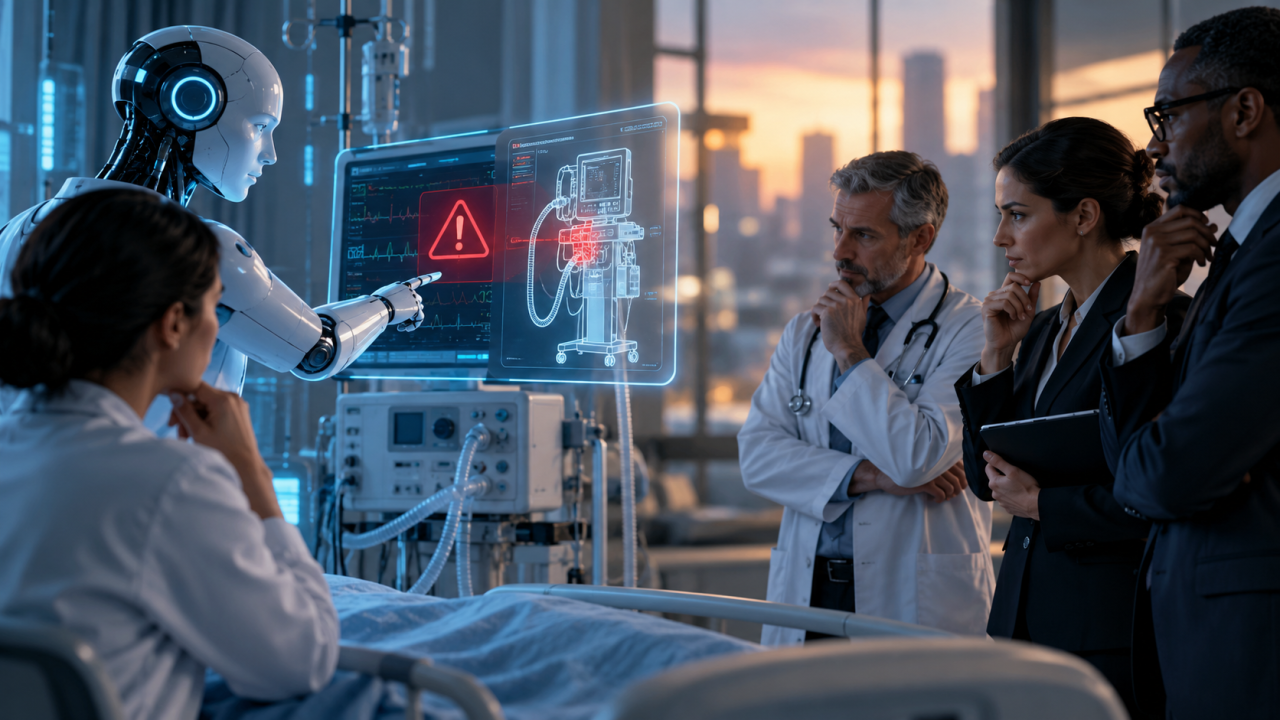
For 2027, we're building on those ideas with a sharper focus. Healthcare is a sector where treating AI as just another tool falls short quickly. When equipment affects patient care, it isn't enough for a model to be accurate most of the time. Someone must own the outcome.
1. Governance will matter more than prediction accuracy
In 2027, we expect healthcare organizations to judge AI in maintenance less on how on how well it's governed as much as on how accurate it is.
That means clear rules about what AI can decide on its own and what it can't. Lower-risk tasks, such as drafting routine work orders or flagging overdue preventive maintenance, can be automated. Higher-risk decisions, especially anything affecting the availability of clinical equipment, must go to a named person. Every recommendation leaves an audit trail.
We've designed our own digital workers on the same principle: lower-risk activities can be automated, while higher-risk decisions are escalated to maintenance professionals. This is especially important in healthcare.
Regulation is pushing in the same direction. In Europe, healthcare is classed as an essential sector under the NIS2 cybersecurity directive, which is now in force in Germany and, since August 2026, in the Netherlands. For hospitals, that puts connected equipment and the systems used to maintain it firmly inside cybersecurity risk management. Meanwhile, the EU AI Act brings its high-risk AI obligations into force from December 2027, with AI embedded in medical devices following in August 2028. Whatever the exact rules for each system, the direction is clear. In 2027, regulators and boards alike will be pushing harder on who's accountable for AI-assisted decisions, and how they're proven.
2. The biomed bench is getting thinner
Healthcare faces the same workforce pressure as every asset-intensive sector, with an extra twist: devices are getting more complex just as the people who maintain them are retiring. Across sectors, 63 percent of maintenance professionals in our Maintenance Trend Report named the aging workforce as the most pressing trend affecting their maintenance strategy.
The pressure is well documented. In the UK, the Institute of Physics and Engineering in Medicine estimates the medical physics and clinical engineering workforce needs to grow by 44 percent on average to meet demand, with the annual intake of new clinical technologists needing to rise by half.
In Germany, the professional association for biomedical technology, fbmt, reports that the ongoing skills shortage is making medical technician roles increasingly hard to fill, to the point that employers are recruiting from related professions to plug the gap.
In 2027, we expect hospitals to start treating knowledge capture as part of patient safety. When a senior biomedical technician knows a certain model of infusion pump tends to fail in a particular way, that knowledge should be captured in their system, where every technician on every shift can find it.
3. Capital pressure will keep older equipment in service longer
Hospital budgets are split across many different systems and replacing major equipment is expensive. Many organizations will keep assets running longer than planned, which raises the stakes on every repair-or-replace decision.
In the US, hospitals are spending heavily on capital, at the highest rate since 2008 according to Fitch Ratings, yet the average age of hospital plant still stands at a record 12.7 years. And not everyone can keep up. Fitch warns that underinvestment at weaker hospitals could create patient safety risks.
Our prediction: in 2027, maintenance leaders will be asked to back those decisions with evidence rather than instinct, showing finance teams the remaining life, failure risk, service history, and cost of each option. Organizations with clean, connected asset data will make those calls faster and with more confidence.
4. As care moves home, maintenance follows
One of our 2026 predictions was that predictive maintenance would extend into patients' homes. In 2027, we think this becomes one of the most human stories in healthcare maintenance.
For a patient relying on home oxygen or dialysis equipment, reliability is the difference between staying at home and going back into hospital. Predictive maintenance on distributed devices can mean fewer emergency callouts, fewer missed treatments, and more people able to receive care where they're most comfortable.
What to do now
Start by understanding where your organization stands. Our EAM Maturity Model offers a practical framework, and the Ultimo Maintenance Trend Report shares wider data on workforce, AI, and maintenance strategy. For more on why technology alone isn't the answer, read AI is Advancing Asset Maintenance but Still Needs Human Ingenuity.
