
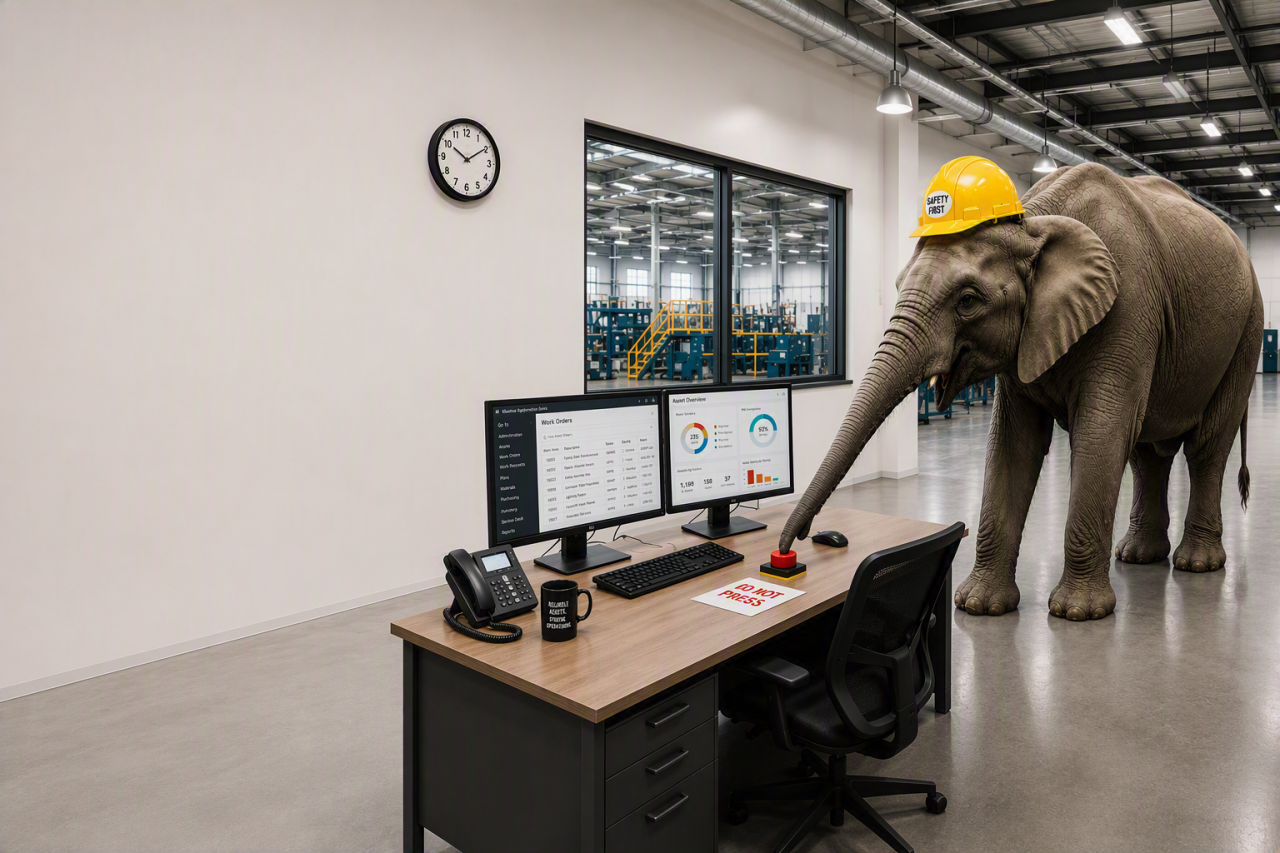
In this blogpost, we cover those elephants and we let you know how these can be removed.
1. Each site follows the standard process differently
On paper, there is one way to raise a request, plan preventive maintenance and close out a job. On the floor, every site has adapted it. Some changes were good local decisions, some were a shift lead's preference, and some are workarounds left over from the old system.
Nobody is doing it wrong. They're doing it differently. The result is that asset names, failure codes and close-out notes mean slightly different things at each plant. Comparing one pump's reliability across three sites turns into an argument about definitions before anyone gets to the analysis.
2. Your people don't trust the data
Inconsistent input produces data nobody fully believes, so people fall back on experience instead. The senior technician knows which compressor acts up in summer. The planner knows which work orders to ignore.
That works until the person who knows is on leave or retires. Meanwhile, repairs are getting slower. The average repair now takes 81 minutes, up from 49 minutes five years ago. When the history can't be trusted, every job starts closer to zero.
3. Software is live. Transformation is not.
Go-live is a project milestone. It proves the system works, but it says nothing about whether the way people work has changed.
Plenty of organizations celebrate the cutover and stand down the project team. Months later, technicians still log jobs at the end of the shift, if at all, and the reports leadership asked for are still being put together by hand.
The software didn't fail. The change was never designed in. Nobody mapped how work really moves between operations, maintenance and HSE, and nobody made the new way easier than the old one.
4. Improvement doesn't travel
When processes differ and the data is doubted, a good idea at one site stays at that site. Say a plant cuts repeat failures on its conveyors. Its sister plant can't adopt the method, because the asset structure, failure codes and workflow don't line up.
Improvement becomes a local success story rather than something the whole organization owns. The reverse is the point of the series: once processes become consistent, improvement becomes scalable.
How Ultimo and MaxGrip tackle them together
None of these four is purely a software problem, and none is purely a consulting problem. That's why we work on them as a pair.
MaxGrip starts with the work as it actually happens. Its consultants map how requests, planning, execution and close-out run at each site. They agree a common standard with the people who will use it, and they set up the asset hierarchy and data definitions that make sites comparable. They also stay through adoption, so the change reaches the floor and not just the project plan.
Ultimo makes that standard the easiest way to work. Templated solutions for each industry give sites decades of maintenance best practice as a starting point, instead of a blank page. With the Ultimo Configuration Tool, your own team can adjust workflows as you learn, without needing developers or consultants for each change.
Maintenance, facilities, safety and inventory all run on one platform, so every site works from the same model and the same database. Mobile work orders let technicians record information where the job happens, which is where trust in the data is won or lost. Customers can be live in as little as three months, which keeps the focus on the change rather than on a long project.
That consistent foundation is also what makes AI useful. Put AI on top of inconsistent data and it just automates the inconsistency. On clean, shared data, embedded AI suggests next steps and a person reviews and confirms them.
A great example of our joint work is our case at EUROGATE Technical Services, which maintains mission-critical terminal infrastructure in Bremerhaven, Hamburg and Wilhelmshaven. MaxGrip is implementing Ultimo in phases across the terminals. The rollout brings mobile working to around 450 technicians, and MaxGrip is guiding the move from the previous EAM system to a reliability-driven way of operating.
Want to know more? Meet us at IMC 2026
December 7–10, 2026 | JW Marriott Marco Island Beach Resort
